

Income Drawdown
Have the flexibility to withdraw money as and when you need it


So what is income drawdown?
Income drawdown, or pension drawdown, gives you the freedom to keep your pension invested
Let's explain...

Income drawdown, also known as a pension drawdown or drawdown investment, gives you the flexibility to withdraw money from your pension whilst keeping the rest invested. Its aim is to help your pension continue to grow throughout your retirement.
Pension drawdown suits people who are prepared to take some investment risk in return for a potentially higher income, or people who want the flexibility to vary their income and dip into their savings from time to time.
The information on this page should not be considered as financial advice. If you are unsure what’s right for you, please make sure you speak to a financial adviser.
Features of a pension drawdown
With a pension drawdown, you can help your income stretch further


How income drawdown works
Receive your pension when you need it most, and leave it invested when you don’t
Here’s how income drawdown works
1. Get access to your tax-free allowance
When you place your pension into drawdown, you can normally take up to 25% of it tax-free. Tax-free cash must be taken upfront, but if you’d prefer to spread it out, you could move your pension into drawdown gradually, allowing you to take a 25% tax-free entitlement each time.
As you withdraw some or all of your tax-free allowance, the remaining amount will be transferred to pension drawdown where any further withdrawals are taxable.
2. Choose how you receive your cash
It’s your choice what you do in your retirement, but you’ll want to make sure you have enough money to support you. Of course, with pension drawdown, you can either take what you need, when you need it, or you can set up regular withdrawals. So, if you have a big holiday planned, you can take a lump from your pension. Or, if it’s there to pay your bills, you have the freedom to do so.
3. Review and monitor your balance
Just like your current and savings accounts, it’s important you keep an eye on what’s remaining and how your pension is performing. Remember, with most investments, your amount can go up or down. So, you’ll want to review your investment options regularly to ensure you’re happy with the risk involved.
Tax and income drawdown
Taking your pension through income drawdown does have some tax considerations
When taking money from your pension pot, any amount above the tax-free lump sum will be taxed as income in the same tax year. For instance, if you have a pot of £80,000 and take a tax-free lump sum of £20,000, you'll be left with £60,000 to invest.
If you withdraw an annual income of £3,000 from your pension pot and are a basic rate taxpayer, you'll pay 20% tax, resulting in a net income of £2,400. Be aware that large withdrawals may push you into a higher tax bracket.
To minimise tax liability, consider spreading payments and/or transferring your money into drawdown over multiple tax years. Note that when you first take income, your provider will usually need to deduct emergency tax from your payments at first – this means that you may initially pay the wrong amount of tax, which will need to be reclaimed or refunded by HMRC later on.
Additionally, since the 2024/25 tax year, the ‘lifetime allowance’ has been replaced by the ‘lump sum allowance’ and ‘lump sum & death benefit allowance’. These provide new thresholds limiting the maximum amount of tax-free benefits that can be taken from a pension fund.
Faqs about how income drawdown works
We know you may still have some unanswered questions, so here’s what you need to know
Learn more about income drawdown

What can you get from your pension fund?
The total amount you can get depends on various factors, like how much you’ve saved, the type of risk you choose for your pension and where you choose to invest it.
Nonetheless, you’ll still be able to receive up to 25% of your pension tax-free, allowing you to put it away in savings or spend it as you wish.
If you are prepared and able to take some risk, you may find that your pension grows faster with some exposure to stocks and shares. However, faster-growing investments are usually more volatile. Therefore, it can be wise to consider moving money you intend to access in the near to medium term towards guaranteed investments or cash. This means your money is at less risk of sharp drops in value at the point you need to access it.
How much does it cost?
With a pension drawdown, you’ll pay a service charge to your provider which will come out of your pension pot. You might also be charged for fund management. These costs depend on who your provider is, the rates they charge for service and how the markets are performing.
It's also worth noting that after you’ve claimed your tax-free allowance, any other withdrawals you make will be classed as taxable income, so you’ll also need to account for this.
Who can help you understand the risks?
With investments like this, it’s easy to get lost in the jargon. That’s why we recommend using a retirement advice service. They’ll offer an initial consultation that’s free to help understand your needs. If you choose to take their advice, they’ll be able to help you navigate your pension, at a small cost.
Your money is at risk with a pension drawdown, but that’s not necessarily a bad thing. With specialist advice, you can understand these risks in more detail and decide whether a pension drawdown is right for you.
Can you change your mind?
A pension drawdown isn’t right for everyone, that’s why you have the flexibility to change your mind. If you do, you can speak to a retirement advice service that can aid you in choosing a different retirement product, like an annuity.
I have a defined benefit pension, will income drawdown work for me?
Defined benefit pensions, also called a final salary pension, pay out a fixed amount per month and are unable to offer other options, such as drawdown. It is possible to transfer out of a defined benefit pension in order to access drawdown. However, for most people, this isn’t a good idea. If you do wish to consider doing this, you will be required to first seek advice from a qualified Pension Transfer Specialist.
IS INCOME DRAWDOWN A GOOD IDEA?
Let’s weigh-up income drawdown
Advantages of income drawdown

- The income you take can vary; you can choose to receive this regularly, make occasional withdrawals or take nothing at all. It’s entirely up to you.
- Any funds invested when you die can be passed on to your partner or spouse (or any other beneficiary).
- Normally, no income tax applies to your beneficiaries if you die before the age of 75.
Disadvantages of income drawdown

- Your income isn't guaranteed.
- You could run out of money.
- Remember, there's the potential for your investment to go down as well as up, so your money could be worth less in the future.
- Income and investment options need to be reviewed on a regular basis to make sure they still meet your needs.
When is income drawdown right for you?
If you think income drawdown might work for you, you’ll need to consider these factors

- If you’ve spoken with a financial adviser and they’ve suggested it as an option.
- If you’re aged 55 or older with a defined contribution pension.
- If you want control over how you receive your pension.
- If you’re happy to review your investments on a regular basis and make adjustments when they’re needed.
- If you understand the risks and are happy to accept them.
What happens to your drawdown pension when you pass away?
Your pension drawdown isn’t lost when you pass away
If you pass away before you’ve used the funds in your pension drawdown, it will be given to your chosen beneficiary. This could be your spouse, partner, children, other family members or friends. They’ll receive whatever amount is left on your pension.
Your beneficiaries may have to pay tax on the amount they receive, but this all depends on the age you pass away. If you’re under the age of 75, any drawdown benefits can be passed to your beneficiaries tax-free. Otherwise, if you pass away aged 75 or older, your beneficiaries will pay income tax.
It is also important to remember that from 6 April 2027, inherited pensions and unused pension pots will be included in a deceased person’s estate and be subject to inheritance tax under key changes to inheritance tax rules announced in the 2024 Autumn Budget.
How else can you take your pension?
Income drawdown isn’t your only option
There are a number of options to consider with a drawdown arrangement from your pension.

- Savings - You’re not restricted to just one form of income. It’s absolutely okay to top up your retirement fund using savings. Simply take them as you need or invest them.
- Lump Sums - You can take lump sums from your pension pot as and when you need them. This can continue until your money runs out or you choose other options. Every lump sum you take from your pension pot is known as an Uncrystallised Funds Pension Lump Sum (UFPLS).
- Annuities - You can use some or all of your money to buy an annuity at a later stage. It can make sense to consider buying an annuity as you get older.
- Withdraw all the money in one go - You can take out all of your pension savings at once. Usually, 25% will be tax-free and the remainder will be taxable. This option won’t provide you with a regular income and your tax rate might go up when the money is added to your other income.
- Mix and match - You have the flexibility to mix your options over time and your total pension pot. You can also keep paying into a pension and get tax relief up to the age of 75.
UNDERSTANDING YOUR RETIREMENT OPTIONS
Use our handy tools and calculators to see what you could get

Annuity Calculator
Using today's rates, our calculator can give you a snapshot of the income your pension savings could buy you in retirement. You can also choose to add your health details to personalise your quote even more!

FIXED TERM ANNUITY CALCULATOR
Our fixed term annuity calculator gives up to date results based on current rates. We shop around the whole of the market to get you the best quote for your specified income and/or guaranteed maturity value.

Pension drawdown calculator
Our pension drawdown calculator provides a helpful plan of what income you could get if you’re looking to take your pension pot flexibly.

State Pension Age
Looking for your State Pension age and what you can expect to get? Our friends at Gov.uk have you covered.
Advice or guidance
What's the difference between advice and guidance
Advice is given by professional advisers such as IFAs, financial planners, wealth managers and pension specialists. Advice is regulated by the FCA, protecting you from negligent advice and will give you tailored recommendations for your individual circumstances and ensure that the best option or combination of options for your circumstances is found, even if this goes against what you originally thought to be the best decision for you. Taking advice usually costs money.
Speak to one of our expert advisers today and see how we can help you find the best income for your pension. We can:
- Give advice on all types of pensions.
- Maximise your pension income.
- Help you make the best possible use of your hard-earned savings.
Guidance gives a general overview of the options available on the market for free by highly trained specialists. Guidance services won't tell you what to do with your money and you will need to research the market to find the right products and providers to suit your needs and preferences. There's no protection available, but taking guidance is a good place to start to help you understand the various choices available.
For guidance on your defined contribution pension, we recommend visiting Pension Wise, a free government service from MoneyHelper, offers impartial guidance on your pension options.
To book an appointment call 0800 138 3944, 9am to 5pm Monday to Friday, visit their website, or email at [email protected].
Pension Wise won't recommend any products or tell you what to do with your money.

financial advice
Need help?
Have a commitment free chat with one of our expert advisers today. Start your conversation by giving us a little more detail.
Mon to Fri 8.30am-6pm
For TextDirect: First dial 18001
Calls may be recorded and/or monitored for training and audit purposes
BE WARY OF PENSION SCAMS
Keep an eye out for suspicious requests and pension scams
At LV=, we only ever want you to feel safe and secure with your pension and retirement choices. So, here’s what you need to know
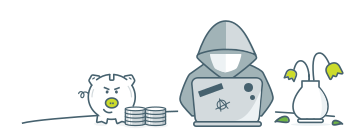
- Watch out for online scams promising free pension and investment reviews. You could be unknowingly giving criminals access to your pension information.
- They may suggest ways to access your pension or investments early, but this is only true in rare cases for specific products.
- Scammers might ask you to transfer your pension as part of an investment scam. If you’re unsure what you should do, speak to someone you trust.
- Legitimate companies are regulated by the Financial Conduct Authority (FCA), whilst scams usually operate outside these regulations, leaving you with no compensation if you fall victim to one.
- If you get an unexpected call claiming to be from us or another provider, don't share any information. Hang up and contact us or the alleged provider using a verified number to confirm the request's legitimacy. Your financial safety is on the line.
- LV= can help you access your pension savings safely and securely giving you peace of mind when the time comes to retire. Find out more information and useful tips here on how to protect yourself from scammers.


